

Blog
Creatine Monohydrate

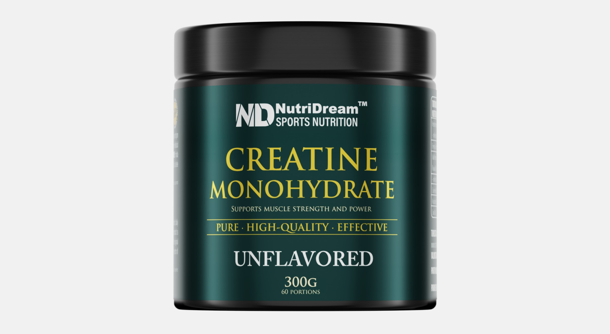
What is creatine and from where is it obtained?
Creatine is a natural chemical compound that is mainly found in muscles and is used during physical activity. The remaining creatine is transported to the heart, brain, or other tissues. The main function of creatine is to provide muscle cells with energy during contraction, which is why it is especially useful in situations where muscles need quickly a lot of energy, such as high-intensity exercise. Creatine is not an anabolic steroid and does not increase testosterone levels in the blood.
Most of the creatine you need comes from protein-rich foods, such as red meat and seafood. The body can also produce a certain amount of the daily creatine requirement in the liver, pancreas, and kidneys from three amino acids: glycine, methionine, and arginine.
How does creatine work?
Most of the creatine is transported to the muscles, where it is converted to phosphocreatine. Phosphocreatine helps to form adenosine triphosphate, known as ATP, in situations where there is a high demand for energy (Figure 1). ATP is the energy source used by cells during exercise. The more ATP in the body, the more energy the body has and the better exercise performance. Creatine therefore helps to maintain a constant supply of energy in the muscles during intense exercise.

Figure 1. To provide immediate energy, phosphocreatine reacts with adenosine diphosphate (ADP), a byproduct of muscle contraction, to form adenosine triphosphate (ATP). During rest, ATP is hydrolyzed back to ADP, and the resulting phosphate group is transferred back to creatine to form phosphocreatine.
Why is creatine beneficial?
Increased physical performance during short, high-intensity, repetitive exercise – Long-term use of creatine (4 to 12 weeks) in conjunction with exercise appears to increase muscle strength due to increased availability of phosphocreatine in the muscles. A meta-analysis has shown that creatine supplementation significantly increases exercise capacity during short, high-intensity exercise (30 seconds). In addition, the number of repetitions performed increases and work capacity improves. The improved performance was also significant for exercise durations of 30-150 seconds, but beyond that the effect became non-existent.
Effect on muscle mass – Previous studies have found that the use of creatine during resistance training promotes the growth of both upper and lower body skeletal muscles. The positive effect of increasing muscle mass is particularly evident in healthy young athletes. However, there is not enough research to claim that creatine helps increase muscle growth in people over 65 years of age or those with diseases that affect their muscles. It has been hypothesized that the increase in muscle mass may be affected by the increase in the proportion of water in the muscle cell, protein synthesis, and the formation of muscle fibers. However, a clinical trial conducted with 54 people that lasted 12 weeks did not show any effect on muscle mass. A small weight gain occurred in women a week after starting creatine, when they had not yet actually started resistance training. At the end of the trial, there was no difference in muscle mass compared to the group that did not use creatine.
Muscle cell repair and recovery – During exercise, muscle fibers undergo micro-tears, and creatine has been found to help muscles repair these tears and prevent injuries. Creatine can speed up muscle recovery after a hard workout because creatine promotes the formation of glycogen in the muscles. Namely, energy from glucose is needed to aid the healing process.
Short-term memory – Since creatine is also found in the brain, certain studies have found that creatine may also be helpful in improving short-term memory.
The European Food Safety Authority (EFSA) has found:
- • Creatine increases physical performance during short-term, high-intensity physical exertion. The beneficial effect is seen when 3 g of creatine is consumed per day.
- • Daily intake of creatine may enhance the effects of muscle training on muscle strength in adults over 55 years of age. The beneficial effect is achieved when 3 g of creatine is consumed daily in conjunction with muscle training that allows for increased load over time and should be performed at least three times a week for several weeks at an intensity of at least 65-75% of one repetition maximum.
To whom?
Creatine is most commonly used by athletes because it helps increase muscle performance, thereby increasing aerobic exercise efficiency and improving recovery. Creatine supplementation is also recommended for people whose diet does not contain creatine-rich foods, such as red meat and seafood.
Creatine as supplement
The most used form of creatine is creatine monohydrate, which increases muscle performance in short-term high-intensity endurance exercises, such as sprinting, cycling, and weight training. Creatine in supplements is mostly synthetically produced in a laboratory, meaning it does not contain animal derivatives. Therefore, synthetically produced creatine is also suitable for vegans. Creatine is mainly used as a supplement by athletes or people who do not get enough creatine from food (vegans).
The recommended safe daily dose for adults is 3-5 grams. Creatine is generally considered safe, but pregnant women, nursing mothers, diabetics, people with liver and kidney diseases, and people with bipolar disorder should still be cautious about its consumption. It is advisable for them to consult their doctor before consuming creatine. However, gastrointestinal disorders (diarrhea, nausea, vomiting) and weight gain may also occur due to increased water content in muscle cells. Weight gain due to fluid retention may occur temporarily in the first weeks of use. Long-term studies have not shown permanent weight gain due to water retention in the body.
References
Avgerinos, K. I., Spyrou, N., Bougioukas, K. I. & Kapogiannis, D. Effects of creatine supplementation on cognitive function of healthy individuals: A systematic review of randomized controlled trials. Exp. Gerontol. 108, 166–173 (2018).
Branch, J. D. Effect of creatine supplementation on body composition and performance: a meta-analysis. Int. J. Sport Nutr. Exerc. Metab. 13, 198–226 (2003).
Buford, T. W. et al. International Society of Sports Nutrition position stand: creatine supplementation and exercise. J. Int. Soc. Sports Nutr. 4, 6 (2007).
Burke, R. et al. The Effects of Creatine Supplementation Combined with Resistance Training on Regional Measures of Muscle Hypertrophy: A Systematic Review with Meta-Analysis. Nutrients 15, 2116 (2023).
Cooke, M. B., Rybalka, E., Williams, A. D., Cribb, P. J. & Hayes, A. Creatine supplementation enhances muscle force recovery after eccentrically-induced muscle damage in healthy individuals. J. Int. Soc. Sports Nutr. 6, 13 (2009).
Desai, I. et al. The Effect of Creatine Supplementation on Lean Body Mass with and Without Resistance Training. Nutrients 17, 1081 (2025).
Doma, K., Ramachandran, A. K., Boullosa, D. & Connor, J. The Paradoxical Effect of Creatine Monohydrate on Muscle Damage Markers: A Systematic Review and Meta-Analysis. Sports Med. 52, 1623–1645 (2022).
EFSA Panel on Dietetic Products, Nutrition and Allergies (NDA). Creatine in combination with resistance training and improvement in muscle strength: evaluation of a health claim pursuant to Article 13(5) of Regulation (EC) No 1924/2006. EFSA J. 14, 4400 (2016).
EFSA Panel on Dietetic Products, Nutrition and Allergies (NDA). Scientific Opinion on the substantiation of health claims related to creatine and increase in physical performance during short-term, high intensity, repeated exercise bouts (ID 739, 1520, 1521, 1522, 1523, 1525, 1526, 1531, 1532, 1533, 1534, 1922, 1923, 1924), increase in endurance capacity (ID 1527, 1535), and increase in endurance performance (ID 1521, 1963) pursuant to Article 13(1) of Regulation (EC) No 1924/2006. EFSA J. 9, 2303 (2011).
Olsen, S. et al. Creatine supplementation augments the increase in satellite cell and myonuclei number in human skeletal muscle induced by strength training. J. Physiol. 573, 525–534 (2006).
Powers, M. E. et al. Creatine Supplementation Increases Total Body Water Without Altering Fluid Distribution. J. Athl. Train. 38, 44–50 (2003).
Wax, B. et al. Creatine for Exercise and Sports Performance, with Recovery Considerations for Healthy Populations. Nutrients 13, 1915 (2021).
Wu, S.-H. et al. Creatine Supplementation for Muscle Growth: A Scoping Review of Randomized Clinical Trials from 2012 to 2021. Nutrients 14, 1255 (2022).